
Is Your Phone Listening to You?
The concern goes beyond an active microphone. Your phone learns from every habit and turns small actions into signals about you. The real question is how much it perceives without you noticing.

The idea that a smartphone captures every word spoken around it sparks growing curiosity.
Many users report situations in which a casual conversation seems to generate related ads moments later. This kind of coincidence raises deep questions about privacy, surveillance and the internal functioning of modern devices.
Is there a hidden mechanism that turns everyday dialogue into commercial data. Or does the feeling of constant monitoring arise from mistaken interpretations. Below is a detailed analysis that explores technical, behavioral and conceptual aspects to understand what truly happens.
What we know
The operation of the microphone is a central point in this discussion. The component remains inactive most of the time and is only activated when an application requests access.
This process depends on permissions granted by the user during installation or use of certain services. Platforms such as privacy settings allow checking which programs have authorization to capture audio.
The architecture of mobile systems was designed to prevent software from using the microphone without explicit consent. When an app attempts to access the resource, the system displays a visual alert indicating sound capture. This behavior is standardized in current devices.
Another essential element involves wake words. Digital assistants such as voice activation depend on specific expressions to start processing commands.
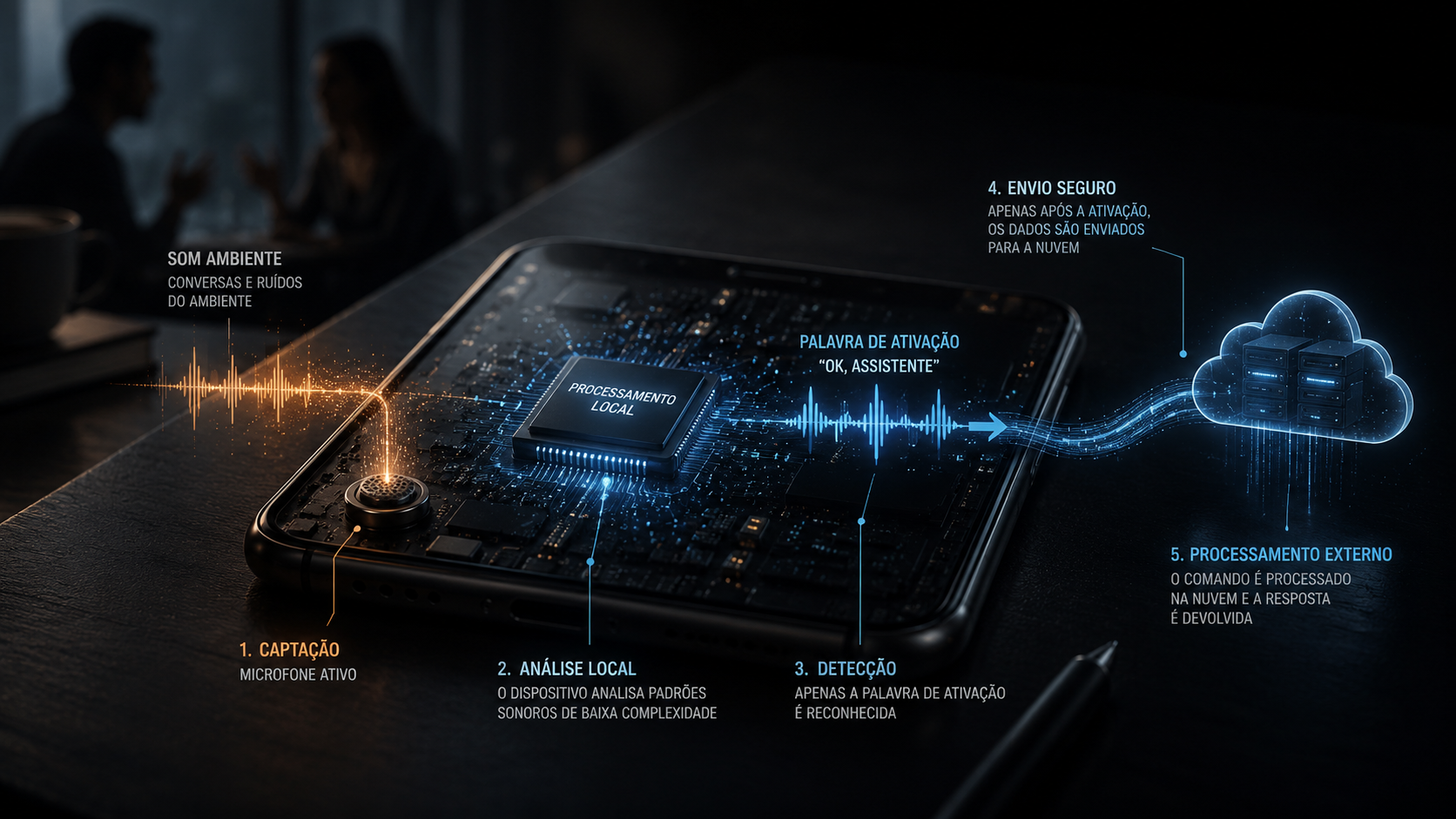
To recognize these expressions, the device maintains a continuous listening module that analyzes low‑complexity sound patterns. This module does not record full conversations. It only identifies acoustic signals that match the activation phrase.
Processing occurs locally and is not sent to external servers until the user pronounces the activation expression. This structure was created to reduce risks of improper exposure.
In addition, targeted advertising systems use behavioral data to display relevant ads. Information such as browsing history, approximate location, social media interactions and consumption preferences are combined to form profiles.
Advertising platforms work with algorithms that cross interest patterns and market trends. When the user talks about a topic already present in their digital behavior, the feeling of surveillance increases. The coincidence between conversations and ads may result from statistical correlations rather than active listening.
What we suspect
The perception that the phone captures private conversations arises from personal experiences that seem very specific. People report mentioning a product for the first time and soon after seeing related ads. This type of situation fuels the idea of constant monitoring.
However, digital security specialists state that coincidences may occur due to the volume of data collected by applications. Advertising platforms use predictive models that anticipate interests based on broad patterns. When the user talks about something already within a general trend, the ad may appear without the microphone having been activated.
Another point that generates suspicion involves permissions granted without attention. Many users accept authorizations without analyzing details. Apps that do not require audio may request microphone access for various reasons.
Although the operating system prevents improper use, concerns exist about companies that exploit loopholes to collect additional data. Lack of transparency in privacy policies contributes to the feeling of surveillance. Interpreting these permissions can create doubts about what is actually captured.
There is also the hypothesis that some services use advanced techniques to correlate ambient audio with consumption patterns. This idea has no solid proof but appears in privacy debates.
The suspicion arises from the combination of sophisticated technology and aggressive marketing strategies. The possibility that companies seek competitive advantage through questionable methods fuels theories about hidden listening. Even without concrete evidence, the topic remains relevant due to its emotional impact.
What is myth
The belief that smartphones record all conversations and send them to servers is presented as a consolidated myth. However, the absence of definitive proof does not completely eliminate doubt.
The volume of data generated by continuous recordings would be unfeasible for transmission and storage, yet technological advances may change this logic over time. Modern operating systems have protection layers that prevent unrestricted microphone access, although isolated incidents have shown that failures can occur.
The idea that every spoken word is captured and analyzed lacks solid technical support, but the feeling that something escapes control persists among part of the specialized community.
Another frequently cited myth involves ads appearing after specific conversations. Targeted advertising uses a variety of sources to determine interests, and browsing history is one of the most influential factors.
Even so, reports of extremely precise situations continue to appear. Selective memory may explain part of these experiences, but does not completely eliminate the impression of deeper correlation. Doubt remains because the boundary between behavioral analysis and ambient listening is increasingly thin.
It is also considered a myth that companies have unrestricted microphone access without authorization. International regulations require transparency and control over sensitive data.
Platforms that violate these rules face severe penalties. Still, isolated cases of abusive practices show that users are not always fully aware of what happens behind the scenes. The narrative of absolute surveillance may be exaggerated, but complete trust in system protection also seems naive given current complexity.
Conclusion
The feeling that the phone hears everything arises from coincidences, mistaken interpretations and lack of knowledge about device functioning.
Although legitimate concerns exist, most suspicions lack solid technical basis. The microphone depends on clear permissions, wake words operate through local processing and targeted advertising uses broad behavioral data.
Even so, the combination of advanced technology and massive data collection creates an environment where the line between myth and possibility becomes increasingly difficult to see.
The real concern should not arise only from the chance of an active microphone. It comes from how much of your habits are silently revealed while you browse, search, share and interact with the device.

Each gesture creates clues that feed systems capable of anticipating desires and predicting behaviors with growing accuracy. The question remains direct and uncomfortable. What represents a greater risk to your privacy.
The possibility of audio capture or the amount of signals you reveal without noticing. The answer requires reflection because the impact is not only in the technology that listens. It is in the technology that observes, interprets and learns from everything you do. The doubt between myth and reality may be the alert needed to rethink your relationship with the device that accompanies every moment of your routine.
To explore the topic further, consider digital security, data protection and online privacy. Awareness is the best tool for navigating the modern technological environment.