
The Hidden Depth of Language Models
Large-scale language models use deep neural architectures to interpret text and generate coherent responses with remarkable precision. Their rapid evolution raises questions about control and the unpredictable future of artificial intelligence.
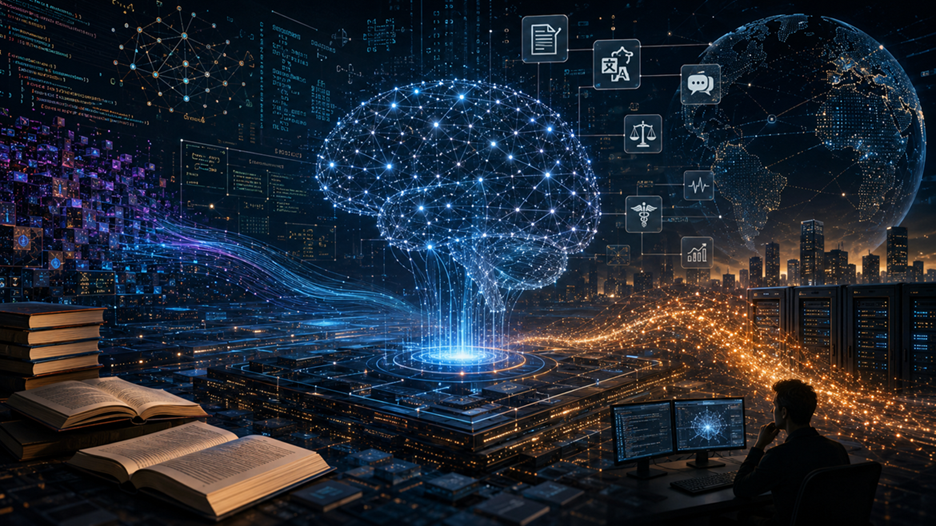
Large-scale language models represent one of the most complex structures ever developed in the field of artificial intelligence. These systems use deep neural networks to interpret textual sequences and produce coherent responses based on patterns learned during extensive training processes. The concept gained strength after research such as that of Vaswani et al., which introduced the transformer and paved the way for architectures capable of analyzing broad linguistic relationships with remarkable precision.
The functioning of these models depends on attention mechanisms that identify connections between distant words in a sentence. This approach replaced recurrent structures that limited the ability to understand long contexts. As investigations advanced, new layers were added, activation functions were refined and pre-training methods became more robust. Each stage of this process contributed to the creation of systems capable of generating complex texts with impressive fluency.
During training, neural networks are exposed to large collections of texts from books, scientific articles and digital pages. The goal is to enable the model to learn linguistic patterns, syntactic structures and semantic relationships. Optimization algorithms adjust internal weights to reduce prediction errors. With each iteration, the system becomes more capable of anticipating the next word in a sequence, which forms the basis of its ability to produce coherent content. Studies such as those by Kaplan et al. demonstrated that increasing the volume of data and the number of parameters tends to improve performance, although it also raises computational costs.
The internal structure of these models consists of attention layers that analyze different aspects of a sentence. Each layer examines relationships between terms, identifies contextual relevance and produces vector representations that synthesize meanings. These representations are progressively refined until the system produces a textual output. The accuracy of this process depends on the quality of the training data and the efficiency of the adjustment algorithms. Recent investigations explore regularization methods that aim to avoid overfitting and ensure that the model generalizes well to new situations.
Capabilities of these systems go beyond text generation. They can perform tasks such as classification, summarization, translation and sentiment analysis. This versatility occurs because the internal structure is flexible enough to adapt linguistic representations to different purposes. In many cases, adjusting the model with specific datasets is enough for it to learn new skills. This process, known as fine-tuning, has proven effective in fields such as medicine, law and engineering.
Understanding how these models operate internally remains a constant challenge. Although weights and gradients can be analyzed, the complexity of deep networks makes it difficult to fully interpret how decisions are made. Investigations such as those by Olah et al. attempt to map internal patterns through visualization techniques, but there is still no consensus on how to fully interpret the internal logic of these systems. This opacity raises questions about reliability, safety and control, especially when models are used in critical environments.
Scalability is another fundamental aspect. As models grow, they require more memory, processing and energy. Research centers invest in specialized hardware to handle these demands. The use of graphics processing units and dedicated accelerators has become essential for training networks with billions of parameters. Studies on energy efficiency aim to reduce environmental impacts and operational costs, although significant challenges remain.
The quality of the responses generated by these models depends on several factors. The diversity of training data influences the ability to handle different linguistic styles. The presence of noise or bias in the data can distort responses. For this reason, researchers dedicate efforts to identifying and mitigating undesirable tendencies. Filtering, curation and auditing methods are applied to improve dataset integrity. However, even with these measures, it is impossible to eliminate all biases, since many are subtle and difficult to detect.
Interactions between users and large-scale language models are also studied. Researchers analyze how people interpret responses generated by automated systems and how this influences decisions. In some cases, users attribute authority to the model that it does not possess, which can lead to misinterpretations. For this reason, investigations into usability and clear communication are essential to ensure responsible use.
Advances in optimization algorithms accelerate the evolution of these models. Methods such as Adam and RMSProp allow more efficient adjustments of internal parameters. Choosing the right algorithm directly influences training speed and prediction quality. Research continues to explore new approaches that aim to reduce computational costs and improve stability during learning.
Security concerns grow as these models become more powerful. Systems can be used to generate malicious content, manipulate information or create texts that imitate specific styles. For this reason, researchers develop protection mechanisms that aim to prevent misuse. These mechanisms include filters, consistency checks and monitoring systems. However, human creativity often finds ways to bypass limitations, which requires constant vigilance.
Corporate and academic environments adopt these models to transform workflows. Companies use automated systems to analyze documents, generate reports and assist with repetitive tasks. Research institutions explore models to synthesize information and accelerate discoveries. This adoption expands the influence of artificial intelligence across various fields, making it essential to understand technical foundations and limitations.
Ethical discussions accompany technological advancement. Issues related to privacy, responsibility and social impact are debated by specialists. The use of large-scale language models requires clear policies that define boundaries and ensure transparency. International organizations propose guidelines that aim to balance innovation and safety. However, implementation varies across regions and sectors, creating additional challenges.
The speed at which these models evolve impresses specialists. Each year brings more efficient architectures, more robust training methods and broader applications. This continuous expansion generates both enthusiasm and concern. Although advances bring significant benefits, they also raise doubts about control and predictability. Increasing complexity makes it difficult to anticipate emergent behaviors that may arise in highly sophisticated systems.
Given this scenario, it becomes evident that large-scale language models represent one of the most influential technologies of the digital era. Their ability to interpret and generate text with surprising precision redefines interactions between humans and machines. Even with accumulated knowledge, there is still no clarity about the limits of this evolution. Each technological leap reveals possibilities that challenge expectations and expand horizons.
Researchers acknowledge that it is impossible to predict the final destination of this technology. Artificial intelligence advances at an accelerated pace and exhibits behaviors that are not always fully understood. Although efforts exist to establish controls and guidelines, the adaptive nature of these systems creates unpredictable scenarios. Society watches with admiration and caution, aware that the trajectory of artificial intelligence may follow unexpected paths. There is no guarantee that all consequences of its expansion can be anticipated, which makes constant attention essential.