
AI Training and the Physical Book Blackout: The New Digital Monopoly in the Making
The rapid digitization and destruction of books for AI expose a future where knowledge may shift from a collective heritage to a resource controlled by a handful of powerful corporations.
The new digital gold hidden on old shelves
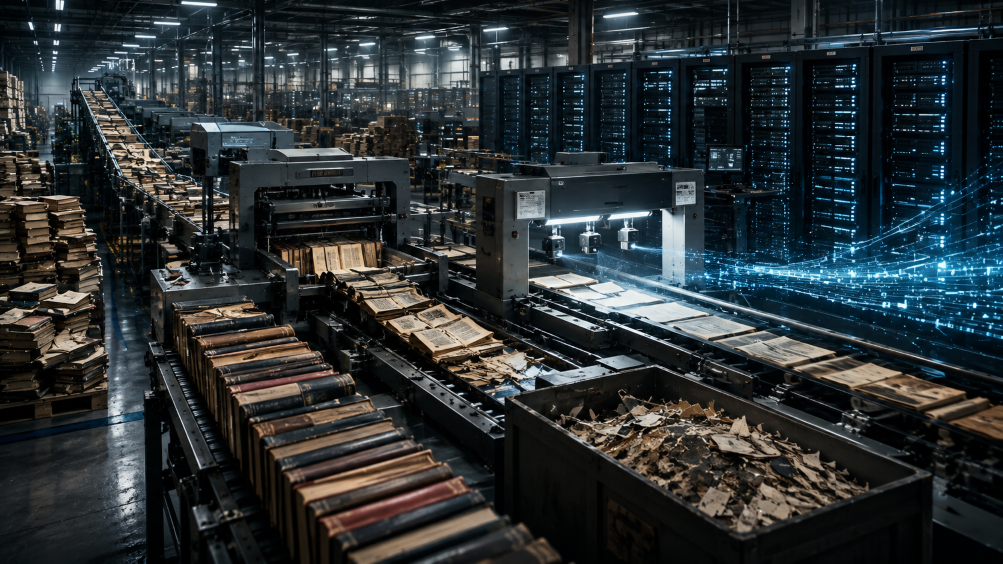
The global race to develop advanced artificial intelligence models has opened an unexpected frontier. Old physical books, especially those published before 2022, have become a valuable resource for technological giants such as Amazon, Google and Meta. These printed materials contain content produced entirely by humans, without interference from algorithms or machine-generated text. This characteristic turns them into a pure data source essential for training systems that rely on authentic natural language.
The search for this collection has triggered an unsettling phenomenon. Companies buy entire batches of works, digitize every page and discard the physical material right after. The process is industrial, fast and efficient. However, the cultural and geopolitical impact of this practice raises deep questions about the future of information and about who will have the power to shape human knowledge.
The Technological Side: Advantages defended by Big Tech
The acceleration of advanced model development
Massive digitization of physical books offers companies a rich and diversified database. Content produced over decades, with varied styles and distinct approaches, feeds algorithms that need to learn nuances of human language. This process allows AI models to become more accurate, more coherent and more capable of interpreting complex contexts.
The collection of printed books also avoids contamination by machine-generated text. This ensures that systems are trained with genuine material, reducing noise and improving response quality. For companies, this technical advantage is essential to maintain global competitiveness.
The digital preservation of rare content
Another argument presented by corporations is the preservation of works that could deteriorate over time. Old books suffer from humidity, mold and natural wear. Digitization creates permanent copies that can be stored on servers and accessed by researchers, students and developers.
This justification is often accompanied by speeches about democratizing knowledge. The idea is that by digitizing entire collections, companies would be saving content that could disappear. In theory, this would expand access to information and protect cultural memory.
Legal security and industrial efficiency
The method used to digitize books involves cutting spines, separating pages and scanning each sheet with precision. This technique reduces errors and speeds up the process. Additionally, by legally acquiring the books, companies avoid disputes over copyright. The material is purchased, processed and discarded without violating intellectual property laws.
For corporations, this model is efficient and safe. It allows millions of pages to be converted into usable data in a short time. The scale is enormous and meets the growing demand for content to train increasingly complex systems.
The Real and Cultural Impact: Deep and irreversible disadvantages
The loss of physical heritage and rare editions
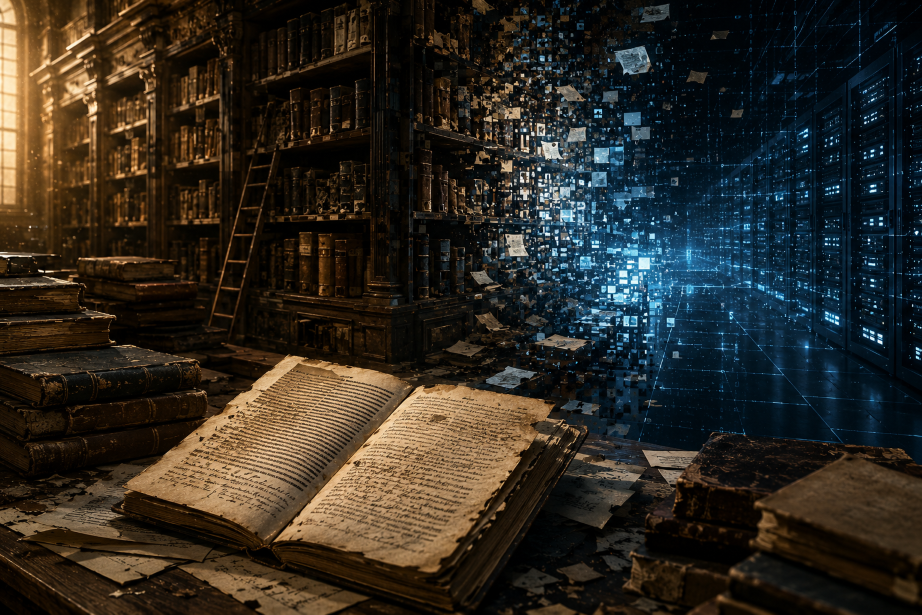
The destruction of books for AI represents a direct threat to cultural heritage. Old works, limited editions and copies that carry history are eliminated after the digitization process. Even if the content is preserved digitally, the physical object disappears forever.
Books are not just containers of text. They carry marks of time, reader notes, printing characteristics and material elements that are part of collective memory. When these items are destroyed, a cultural dimension that cannot be replicated digitally is lost.
The monopolization of knowledge in the hands of a few companies
By digitizing and storing gigantic collections, Big Tech companies begin to control access to content. Knowledge stops being distributed in public libraries and becomes dependent on private platforms. This creates a scenario in which a few corporations hold the power to decide who can access certain materials.
This concentration of information opens space for algorithmic censorship. Platforms can remove content considered inappropriate or sensitive. They can also prioritize certain topics and hide others. Knowledge stops being a public good and becomes a product controlled by corporate interests.
The transformation of the book into a disposable resource
The industrial digitization process treats books as raw material. They are cut, scanned and destroyed. This approach reduces the symbolic value of the book and reinforces the idea that the physical object is irrelevant. Printed culture, which has endured for centuries, loses space to a centralized digital ecosystem.
This change is not only technical. It alters people's relationship with knowledge. The book ceases to be something that can be kept, lent or passed down through generations. It becomes a digital file subject to access rules and corporate permissions.
The Geopolitical Connection: Informational control and the global agenda
The transition from physical to digital as a control tool
The replacement of physical books with centralized digital collections connects to geopolitical debates about information control. When knowledge depends on private platforms, governments and corporations can monitor what people read, search and share. This creates an environment conducive to surveillance and manipulation.
The phrase associated with the World Economic Forum, “You will own nothing and be happy”, is often cited in discussions about loss of autonomy. The migration from physical books to digital reinforces this idea. The citizen stops owning the object and becomes dependent on subscriptions, licenses and permissions. Access to knowledge is no longer guaranteed and becomes conditional.
Algorithmic censorship as a new form of cultural erasure
Algorithms can remove content automatically based on criteria defined by companies or governments. This creates a silent form of censorship. Physical books cannot be erased remotely. Digital files can disappear with a simple internal policy update.
This dynamic places the population in a position of dependence. Knowledge stops being something that can be preserved individually. It exists only within systems controlled by entities that can change rules at any time.
Total dependence on corporate ecosystems
When access to knowledge depends on digital platforms, ordinary citizens lose autonomy. They need connection, subscription and permission. Without these elements, they cannot access content that was previously available in physical libraries.
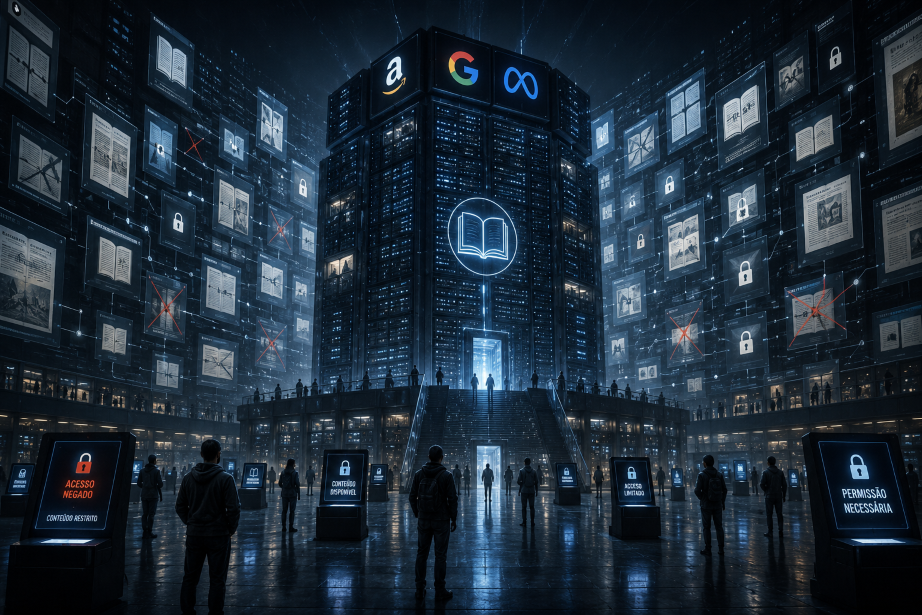
This dependence creates an environment in which corporations have power over education, culture and collective memory. The physical book, which has always been a symbol of intellectual freedom, is replaced by a system that can be shut down or modified without notice.
Conclusion: A necessary reflection on the future of knowledge
The destruction of books for AI reveals a profound transformation in society's relationship with knowledge. Digitization offers technical advantages and preserves content that could be lost. However, the cultural and geopolitical impact of this practice is significant. The loss of physical heritage, the concentration of information and the dependence on private platforms create a scenario that deserves attention.
The question that remains is simple and unsettling. Are we moving toward an era of knowledge democratization or are we funding our own cultural submission? The answer depends on how society reacts to this process and on what limits will be imposed on corporations that control the future of information.